
Close Protection Paris France: Risks and Operations 2026
Paris remains one of the most demanding operating environments in Europe for close protection in Paris, France and other protective work. A principal can move from a private aviation terminal at Le Bourget to a board meeting near Place Vendôme, then to a private dinner in the 8th arrondissement, all within a few hours and through dense traffic, crowds and permanent public visibility.
This is why close protection Paris France is less a question of muscle than a question of planning, timing and discretion. This article explains how protective operations actually work in the capital, what the French regulatory framework requires, what the market charges, and how to brief a provider properly before you hire bodyguard Paris support for a day, a week or a full season.

Close Protection Paris France: Risks and Operations 2026
Reading time: ~9 min
Close Protection Paris France: What the Environment Demands
Core operational challenges in Paris
The capital combines three characteristics that shape every mission. First, density. Movements between the Golden Triangle, Avenue des Champs-Élysées, Avenue Montaigne and Faubourg Saint-Honoré happen on saturated axes where a vehicle can be immobilised in seconds, which makes advance work and route planning far more valuable than reaction speed.
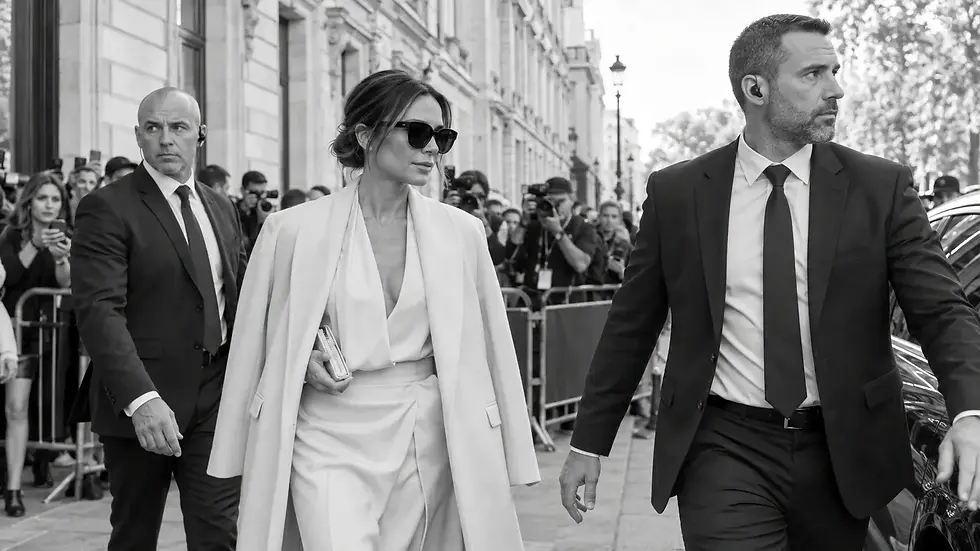
Second, visibility. Luxury retail, palace hotels and cultural venues concentrate photographers, onlookers and opportunistic offenders in the same few streets, so a low-profile operation is almost always preferable to a visible protective detail.
Third, unpredictability of the public space. Demonstrations, spontaneous gatherings and transport disruptions can reconfigure an entire itinerary in the space of one morning, and a credible security programme anticipates that instead of improvising around it.
This is also a market with a clear client profile. VIP protection Paris and executive protection Paris assignments typically involve senior corporate leaders, family offices, exposed public figures and international visitors spending a limited number of days in the city. UHNW close protection France frequently extends beyond the capital, with the same principal moving between Paris, the French Riviera and destinations abroad during the same trip, which is why continuity of standards matters more than the postal address of a provider.
Private Security Regulation France: The Legal Framework Behind Every Assignment
Licensing, compliance and limits
Close protection is entirely legal in France, but it is a regulated activity. Private security regulation France places companies and individual operatives under the supervision of the CNAPS, the Conseil National des Activités Privées de Sécurité. Providers operating on French soil must hold a valid CNAPS authorisation, and each close protection officer (CPO) must hold a personal professional card issued after training and background screening.
Corporate identification such as a SIRET registration is also routinely published by French providers as a compliance signal for international clients. One point deserves emphasis because it is often misunderstood by visiting principals: an operating authorisation confers no prerogative of public authority. A protective detail has no police power, no right to search and no power of arrest beyond that of any citizen, and its legitimacy comes from prevention, positioning and de-escalation.
Armed protection is the exception rather than the norm. In practice, private close protection in France is conducted unarmed, and any carriage of a weapon is subject to strict administrative conditions that are granted only in narrowly defined circumstances. Expectations formed in the United States or in parts of the Middle East therefore need to be recalibrated before arrival, and any serious provider will explain this during the mission briefing rather than after the contract is signed.
Good to know
Verifying a provider means checking that the authorisation number, the corporate identity and the individual professional cards of the assigned operatives all match, and that verification is best done before the assignment, not on the day of deployment.
What a Protective Detail in Île-de-France Actually Delivers
Common close protection services in Île-de-France
Most assignments in the region are built from the same operational building blocks, assembled differently depending on exposure. Here are the services most frequently requested for close protection Île-de-France missions:
Individual close protection, one or several operatives assigned to a principal for business movements, shopping, medical appointments or private engagements, with a personal bodyguard profile for Paris matched to the client's language, culture and working rhythm.
Secure mobility, combining a security chauffeur Paris with defensive driving experience, pre-recced routes, alternate itineraries and, where the risk assessment justifies it, an armoured vehicle.
Residential security Paris, including access control at the property, discreet overwatch of the immediate perimeter, staff vetting advice and a residential security team for extended stays or family presence.
VIP event security in Paris, covering fashion weeks, film and media appearances, product launches, private dinners and galas, with arrival and departure choreography agreed with venue management.
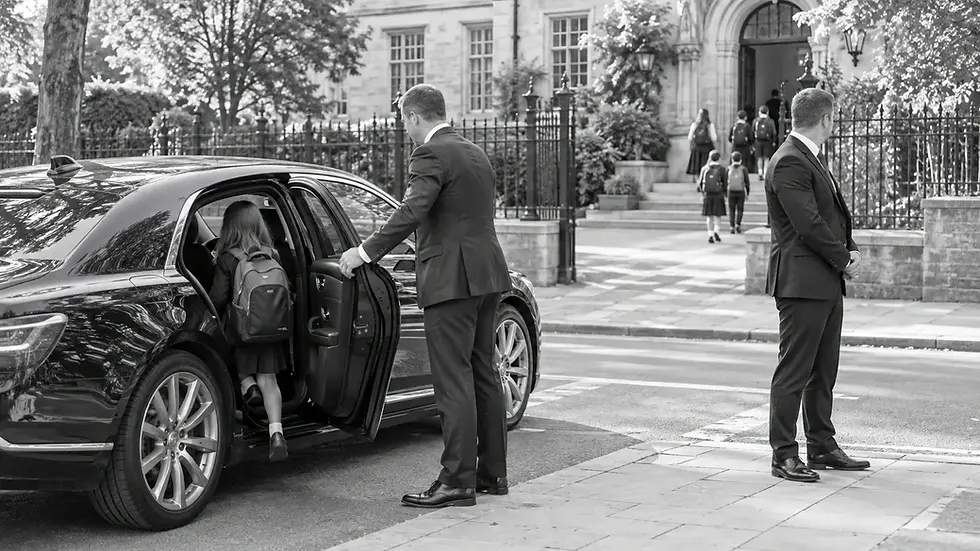
Family and school logistics, with predictable daily runs treated as a specific vulnerability requiring varied timings and counter-surveillance awareness.
Concierge security, where protective coverage is embedded into travel orchestration, private aviation transfers, restaurant and venue access and pre-arrival checks.
From Threat and Risk Assessment to Mission Briefing
Threat and risk assessment, then advance work
A professional assignment starts long before an operative appears in a hotel lobby. The sequence generally begins with a threat and risk assessment covering the principal's profile, media exposure, digital footprint, itinerary, venues and any recent incident affecting peers. That assessment produces a bespoke security protocol, meaning agreed rules for movements, communications, embus and debus points, visitor management and emergency extraction options.
Advance work follows, with venue reconnaissance, identification of secondary exits, medical facility mapping and coordination with hotel security or venue staff.
Mission briefing and international continuity
The mission briefing is the moment when this becomes operational. The assigned close protection officer receives the itinerary, the protective posture, the discretion level expected, the dress code and the escalation chain. Where public gatherings or protests are expected, itineraries are adjusted around them, and liaison with the relevant French authorities and venue operators is handled at the planning stage rather than in the middle of a movement. For principals who then continue to Cannes, Monaco or abroad, the same protocol travels with them, which avoids the classic failure of a strong security set-up in one city and an improvised one in the next.

At IPS BODYGUARD, we design and manage security programmes in more than 100 countries. We provide one accountable point of contact for a client whose week starts in Paris, continues on the Côte d'Azur and ends in Dubai, with documented risk assessments, consistent protocols and 24/7 rapid deployment when a situation changes. Our approach to risk assessment and security audits and our secure transportation framework underpin this continuity across borders.
Security Chauffeur or Close Protection Officer: Two Different Roles
The confusion between the two is frequent and costly. A security chauffeur is first a professional driver, trained in defensive driving, route selection and vehicle-based incident avoidance, who keeps the principal mobile and reduces exposure during transfers.
A close protection officer is a protective operative whose responsibility is the principal on foot, at venues, in lobbies, at receptions and in crowds, with counter-surveillance awareness and medical response skills. A bodyguard-with-driver configuration in Paris keeps both functions separate, which is the correct answer whenever the principal leaves the car regularly. In France, close protection and passenger transport are two separate regulated activities. The protection officer may drive the client's own vehicle as part of the protective assignment, and when a chauffeured vehicle is required, we integrate a licensed professional chauffeur into the detail.
What Close Protection Costs in Paris
In Paris, close protection is billed as a 12-hour daily package, in the range of 700 to 1,500 euros excluding VAT per officer, depending on profile, risk level and notice. Vehicle, accommodation and mission expenses are added where applicable.
The main cost drivers are the assessed risk level, the number of operatives and shift pattern for coverage beyond twelve hours, the vehicle class and any armouring, the language and profile requirements, the notice period, and whether residential coverage or event support runs in parallel. A day rate bodyguard arrangement suits a single meeting, a court appearance or a shopping day, while a season on the Riviera or a multi-city tour is normally structured as a programme with agreed rotations.
Important
A quote that arrives without any questions about your itinerary, your exposure and your venues is a warning sign, because pricing without a requirement means the protective posture has not been thought through.
How to Choose a Close Protection Company in France
Selection criteria matter more than marketing language. The following points are the ones that separate a reliable partner close protection company in France from an improvised arrangement:
Verifiable compliance, with valid authorisation, corporate identification and individual professional cards for every assigned operative.
Documented methodology, including written threat and risk assessment, advance work notes and a protocol you can present to a board or a family principal.
Profile matching, meaning operatives whose language, dress, cultural fluency and discretion fit the environment rather than a uniform tactical aesthetic.
Continuity beyond the capital, with the ability to maintain the same standard in the French Riviera and abroad without you sourcing a new provider at each stop.
Clear accountability, one point of contact, a defined escalation chain and availability around the clock, as described in our executive protection services.
Reasonable lead time behaviour, meaning a provider who can mobilise quickly but still insists on a briefing before deployment.
Which Parts of the City Are Typically Covered
Most assignments concentrate on the central business, luxury and residential districts, the 1st, 7th, 8th and 16th arrondissements, together with the axes linking them to Roissy, Orly and Le Bourget. Coverage in practice extends across Île-de-France for residential requirements, schooling runs, Versailles, corporate campuses in La Défense and the western suburbs.
Because principals rarely stay in one place, a Paris assignment is often the first segment of a wider itinerary towards Cannes, Saint-Tropez, Monaco or Geneva, and planning the whole chain at once is more effective than commissioning three disconnected arrangements.
Planning Your Close Protection Programme Beyond Paris
Protective work in the French capital rewards preparation, cultural fluency and restraint. The regulatory framework is clear, the operating environment is well documented, and the market offers transparent benchmarks for a day rate bodyguard as well as for structured programmes. What varies is the quality of the assessment behind the deployment.
If you are planning a visit, a season, a residence or a high visibility appearance, we can help you structure the requirement, define the protocol and manage delivery through licensed local partners, in Paris and wherever the itinerary continues. You can outline your requirement whenever you are ready to move forward.
Key Takeaways on Close Protection Paris France
Close protection Paris France brings together a demanding urban environment, a strict regulatory framework and a mature service market. Structuring your requirement, selecting a licensed provider and planning your itinerary as a single programme across Paris, the Riviera and any onward destinations will do more for your security than adding visible manpower at the last minute.
Frequently Asked Questions About Close Protection in Paris
Can I hire close protection in Paris for a single day or a single event?
A mission is billed as a 12-hour day, except in exceptional cases for our established clients.
How far in advance should a Paris assignment be booked?
Seventy two hours is comfortable for a standard business itinerary, and two to three weeks is preferable for events, family logistics or anything involving armoured vehicles and multiple operatives. Urgent mobilisation is possible, although advance work will then be compressed and the protective posture adjusted accordingly.
Will a protection detail attract attention in a hotel or a restaurant?
Not if the posture is correct. In central Paris the working default is discreet protection, with business dress, spacing adapted to the venue and no visible equipment, so that the operative reads as part of the entourage rather than as a security presence.
Does close protection include digital exposure?
It should. Home addresses, vehicle registrations, school names and travel patterns frequently leak online before any physical incident occurs, so an assessment that ignores digital footprint is incomplete. Guidance on that side of the exposure is available through our cyber security and digital awareness resources.
Can the same arrangement follow a principal from Paris to the Riviera or abroad?
Yes. Depending on the destination and the nature of the trip, we arrange continuity of the protective detail, with the same protocol and the same point of contact.


Comments