
Bodyguard French Riviera Côte d'Azur, 2026 Client Guide
The French Riviera concentrates, within a short stretch of coastline, an exceptional density of private wealth, prestige events and seasonal visibility, which makes the bodyguard French Riviera Côte d'Azur market both intense and highly visible. Between May and September, villas, marinas, hotel lobbies and private terminals fill with people whose public exposure rises far faster than their protection arrangements.
Hiring a bodyguard on the French Riviera is therefore rarely a simple booking question, it is a planning question. This guide explains how close protection actually works in Nice, Cannes, Monaco and Saint-Tropez, what the French private security regulatory framework requires, what really drives cost, and how to keep one consistent standard from your residence to your yacht and your next departure.

Bodyguard French Riviera Côte d'Azur, 2026 Client Guide
Reading time: ~10 min
Why the Côte d'Azur Is a Specific Operating Environment
Key risk factors on the Côte d'Azur
The Alpes-Maritimes department and the Var coast behave very differently in July than in February. The seasonal influx multiplies traffic, saturates the coastal road network, fills the marinas and turns ordinary movements into slow, predictable and observable journeys.
Predictability is the main vulnerability on the Riviera, far more than any single dramatic scenario. A principal who leaves the same villa gate at the same hour, parks in the same hotel forecourt and dines on the same port every evening becomes easy to follow for anyone paying attention, whether that is a photographer, an opportunistic thief or someone conducting hostile reconnaissance on a property.
The second factor is media exposure. During the Cannes Film Festival, the Monaco Grand Prix and the summer gala season, the perimeter between private and public life almost disappears. Arrivals are filmed, guest lists circulate, and social media publishes locations in real time.
The third factor is mobility. Very few clients stay in one town. A typical stay involves Nice Côte d'Azur airport, a villa in Mougins or Cap d'Antibes, meetings in Monaco, a lunch in Saint-Tropez and a yacht moored in Cannes or Antibes. Each transition between land, sea and air is a moment where responsibility can fall between providers.
This is precisely where fragmented arrangements fail. A villa guarding contract does not cover the road. A chauffeur company does not run a threat assessment. A yacht crew is not trained for red-carpet security management. IPS BODYGUARD designs and manages security programmes that treat the whole stay as a single operation, delivered through a network of licensed local partners, with one operational point of contact from the first briefing to the final departure.
Bodyguard, Close Protection Officer or Security Guard
Roles and responsibilities in private security
These three terms are used interchangeably in everyday conversation, and the confusion costs clients money and effectiveness. A security guard protects a place. A close protection officer protects a person. A bodyguard, in common usage, is the same role as a close protection officer, but the professional term matters because it describes a skill set rather than a physical presence.
A close protection officer works from a risk profile and a threat assessment, plans routes and alternatives, conducts advance reconnaissance of venues, manages arrivals and departures, applies counter-surveillance awareness and knows how to withdraw a principal from a deteriorating situation without creating a scene. Static residential security focuses on perimeter management, access control, patrol patterns and alarm response.
Executive protection adds the corporate dimension, with documented protocols, travel risk advisory and reporting that a board or a family office can audit. Most Riviera missions combine all three, which is why the composition of the protective detail should follow the assessment, not a price list.
Good to know
A well-designed close protection plan is measured by what does not happen. Most of the value is produced in the planning phase, before the first vehicle moves, through advance reconnaissance, route planning and venue coordination.
Licensing in France and How to Verify It
Regulation and due diligence in France
Private security in France is a regulated activity. Individuals carrying out regulated private security work are generally required to hold a professional card issued by CNAPS, the Conseil National des Activités Privées de Sécurité. According to CNAPS, this card is valid for five years and must be renewed before expiry.
Professional aptitude is also a condition of eligibility: it can be demonstrated through approved training, a registered professional qualification, or recognised equivalence for certain police, military or security backgrounds, alongside background checks.
As a client, you should ask three simple questions before signing anything. Who is the legal entity delivering the service on French soil, are the assigned personnel able to present a valid professional card, and does the provider carry professional liability insurance. A serious partner will answer without hesitation and will put the scope of service in writing.
IPS BODYGUARD works exclusively with licensed local partners in France and verifies credentials, training records and insurance cover before a mission is confirmed, so that your documentation stands up to scrutiny from a family office, an insurer or a corporate compliance team.
Important
No provider can promise absolute safety, and any company that does should be treated with caution. What a professional partner can commit to is a documented scope of service, verified personnel, clear escalation procedures and consistent standards.
Close Protection in Nice, Cannes, Monaco and Saint-Tropez
City-specific operating profiles
Each destination has its own operational character. In Nice, the dominant issue is the airport interface. Nice Côte d'Azur handles a very high volume of business and private aviation traffic, and the transition from terminal or private apron to vehicle is the moment of highest exposure for an arriving executive. Executive protection Nice missions therefore start with terminal coordination, meet and greet arrangements, baggage handling and a pre-planned route that avoids the coastal bottlenecks at peak hours. To hire a bodyguard in Nice for a short business visit, a single close protection officer working with a trained security driver is often sufficient.
In Cannes, the calendar dictates everything. During the festival season, the area around the Palais des Festivals et des Congrès, the Croisette hotels and the Port Canto marina becomes a compressed environment with limited vehicle access, heavy pedestrian density and constant media presence. Bodyguard Cannes assignments require accreditation management, venue liaison, drop-off point negotiation and a clear plan for the walk between vehicle and entrance.
In Monaco, the constraints are the tunnels, the underground car parks, the vertical layout of the Principality and the Grand Prix period, when the circuit closes normal routes for several days. A bodyguard Monaco detail must know these movement patterns before the client arrives, not discover them on the day. Monaco has its own private security authorisation regime, and assignments there are delivered by partners authorised in the Principality.
Saint-Tropez and Ramatuelle present a different profile. Access is slow, the beach clubs and villas are spread out, and evenings run late. A personal bodyguard Saint-Tropez assignment is often more about discreet movement management, vehicle staging and knowing the venues than about visible presence.
Destination | Main operational challenge | Typical protective response |
Nice | Airport interface and terminal exposure | Terminal coordination, meet and greet, pre-planned routes |
Cannes | Festival crowds, media, restricted access | Accreditation management, venue liaison, drop-off planning |
Monaco | Tunnels, underground car parks, Grand Prix closures | Advance route mapping before arrival |
Saint-Tropez | Slow access, dispersed venues, late evenings | Discreet movement management, vehicle staging |

Across all four destinations, the same principle applies to close protection Côte d'Azur work, low profile protection that blends with the environment is almost always more effective than an intimidating posture, and it is what most clients actually want.
Villa, Estate and Yacht Security
Most incidents affecting wealthy residents on the Riviera concern property rather than persons, which makes villa security Côte d'Azur a core part of any serious plan. It begins with a security audit and a site survey, covering the perimeter, lighting, vegetation cover, entry points, gate protocols, camera coverage, alarm response times and, crucially, household staff procedures.
Technology alone rarely fails. Procedures fail, usually at the gate, with deliveries, contractors or unverified visitors. Residential security combines a physical presence with strict access control and a written emergency escalation protocol that everyone in the household understands.
Yacht security requirements in Monaco and Cannes add another layer. A vessel at anchor off Cap Ferrat, moored in Port Hercule or berthed at the Vieux Port during a festival is a highly visible asset with a rotating population of crew, guests, contractors and tenders. Maritime security operations focus on tender movement control, guest screening at the passerelle, shore side transitions and superyacht escort during port calls.
The critical point is continuity. The same team that manages the villa should brief the team handling the marina, so that the principal never crosses an unprotected gap between the gate, the quay and the deck.
Secure Transportation and the Security Driver
On a peninsula with limited road options, driving is protection. A security driver French Riviera assignment is not a chauffeur service with a different label. It involves route planning with primary and alternative itineraries, embus and debus procedures, vehicle staging at venues, awareness of following vehicles and the ability to keep moving when a situation develops.
In France, close protection and passenger transport are two separate regulated activities. The protection officer may drive the client's own vehicle as part of the protective assignment, and when a chauffeured vehicle is required, we integrate a licensed professional chauffeur into the detail. On higher exposure missions, separating driving from close protection is strongly recommended, because a driver who leaves the vehicle to escort a principal leaves the extraction option behind.
How Much Does a Bodyguard Cost on the Côte d'Azur
Main factors influencing close protection cost
There is no official tariff for close protection in France. Close protection is billed as a 12-hour daily package, in the range of 700 to 1,500 euros excluding VAT per officer, depending on profile, risk level and notice. Vehicle, accommodation and mission expenses are added where applicable. Villa and event coverage are quoted case by case.
Several factors explain the range, and understanding them helps you compare proposals on substance rather than on headline price.
Number of officers and the composition of the protective detail
Duration, daily hours and whether coverage is continuous or limited to selected movements
Risk profile established by the threat assessment
Requirement for a security driver and the class of vehicle
Residential or maritime components, which add static hours
Event complexity, accreditation and venue constraints
Advance reconnaissance and planning time before arrival
Travel, accommodation and subsistence for deployed personnel
Planning, Booking and What We Need From You
For ordinary business travel, a few days of notice is usually enough. For the Cannes Film Festival, the Monaco Grand Prix or the August peak, qualified personnel and suitable vehicles are committed early, so requests should ideally be made several weeks to several months ahead. Late requests can still be handled, but the choice of profiles narrows and rates rise.

To produce an accurate proposal for VIP security French Riviera missions, we ask for a limited set of practical details, handled under strict confidentiality.
Dates, arrival and departure points and the outline itinerary
Number of people to protect, including children, and any mobility needs
Type of accommodation, villa, hotel, residence or yacht
Planned public appearances, events or media exposure
Desired visibility level, from discreet to overt
Vehicle and driver requirements
Language preferences for the close protection officer
Any existing security arrangements, staff or technology in place
Family Protection on the Riviera
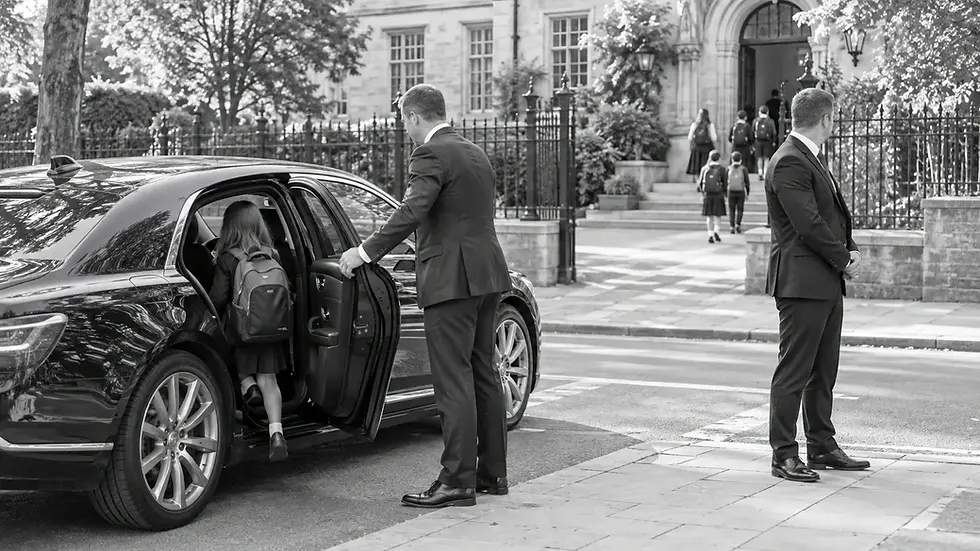
Family protection Côte d'Azur missions require a different temperament. Children notice everything, and protection that feels like surveillance damages family life. The objective is a discreet close protection service that families on the French Riviera barely notice, built around school and activity runs, beach club routines, low profile vehicles and officers who are comfortable in a domestic environment.
Multilingual close protection officers matter here, because the person spending the day with a family should be able to communicate naturally with them and with local staff.
One Standard, In France and Beyond
IPS BODYGUARD designs and coordinates security programmes in more than 100 countries, with a single point of contact for planning, follow-up and escalation wherever the principal travels.
Depending on the destination and the nature of the trip, we arrange continuity of the protective detail, with the same protocol and the same point of contact.
Planning Your Protection on the Côte d'Azur
If you are preparing a stay, an event or a relocation on the coast, the most useful first step is a conversation followed by a risk assessment. You can explore our executive protection, residential security and secure transportation services at ips-bodyguard.com, or request a tailored proposal through our quote request page. A clear plan built two months before arrival always costs less, and works better, than an emergency call on the first evening.
Frequently Asked Questions
Can protection be arranged for a single day?
A mission is billed as a 12-hour day, except in exceptional cases for our established clients.
What happens if the itinerary changes during the stay?
Itineraries on the Riviera change constantly, and a protection plan should be designed for that. Changes are managed through the operational point of contact, who updates route planning, reconfirms venue access and adjusts the roster. Significant changes in scope, such as adding a yacht leg or an overnight requirement, are confirmed in writing before they take effect.
Do you also address digital exposure?
Yes. Physical risk on the coast is frequently triggered by online information, including geolocated posts, published property details and leaked addresses. Our digital awareness and OSINT related advisory covers footprint reduction, doxxing prevention and household cyber hygiene, and it is often the most cost-effective part of a protection programme.
What happens when we travel beyond France?
Mission planning, briefing standards and reporting remain constant, so the experience stays consistent from one destination to the next.
How is confidentiality handled?
Information is shared strictly on a need-to-know basis, non-disclosure terms are standard, and personnel are briefed never to discuss assignments, locations or identities. Client information is never used in marketing, and we do not publish the names of our clients.


Comments