
Security Driver vs Chauffeur – What Really Sets Them Apart
Updated: 1 minute ago
Security driver or chauffeur? The two titles sound similar, and the cars often look the same, yet the missions behind them are very different. A chauffeur delivers a comfortable, punctual and discreet journey. A security driver delivers protected mobility, where every route, stop and arrival is part of a wider protective plan.
For executives, family offices and public figures, understanding this distinction is the first step towards choosing the right level of service. This guide explains what each professional does, how they are trained, and when one is more appropriate than the other.

Reading time: ~9 min
Security Driver vs Chauffeur – What Really Sets Them Apart
Security driver vs chauffeur, the core difference
Scope of service and responsibilities
The distinction between the two roles rests less on the job title than on training, experience, responsibilities and the agreed scope of service. A chauffeur sells a professional ride. A security driver offers a broader capability that combines driving with planning, threat awareness, contingency management and coordination with a protection team.
This matters because terminology varies from one provider to another. Some chauffeurs hold security qualifications, and some security drivers also offer an excellent hospitality experience. When you compare services, look at what the driver is trained and mandated to do, not only at what the role is called.
What is a chauffeur?
Primary role and focus
A chauffeur is a professional driver whose priority is the quality of the journey. Typical duties include safe and punctual transportation, passenger comfort, discreet customer service, vehicle presentation and maintenance, local route knowledge and reliable communication. A good chauffeur anticipates your schedule, keeps the cabin calm and quiet, and makes business travel feel effortless.
The responsibility of a conventional chauffeur usually covers the journey between pickup and destination. Once you step out of the car, the chauffeur may wait, park nearby or leave for another booking. The route is generally chosen for efficiency or familiarity.
In France, many executive transport services operate under the VTC framework (voiture de transport avec chauffeur), which regulates passenger transport rather than protective duties.
What is a security driver?
Protective mission in motion
A security driver, sometimes called an executive protection driver or close protection driver, is a protection professional who drives as part of a broader security mission. Before departure, a security driver reviews the itinerary, prepares primary and alternative routes, identifies choke points, checks pickup and arrival points, inspects the vehicle and confirms emergency contacts with the protection lead.
During the journey, the security driver maintains defensive situational awareness, observes surrounding vehicles and behaviour, adapts the route when circumstances change and follows agreed communication procedures. Counter-surveillance awareness is part of the role, as is the ability to apply emergency and evasive driving procedures if a situation develops.
The mission does not end when the engine stops. A security driver selects a safer stopping position, assesses the entrance, coordinates the principal's movement into the building and then stages the vehicle for an efficient departure. When you are inside a meeting, the vehicle remains ready for schedule changes. This is what we mean by secure arrivals and departures.
Security driver vs executive chauffeur, key differences
The difference between a security driver and a chauffeur becomes clearer when you compare them criterion by criterion.
Criterion | Chauffeur | Security driver |
Primary objective | Comfort, punctuality and service | Secure movement and risk reduction |
Core training | Professional driving and customer service | Adds protective driving, threat awareness and emergency response |
Route planning | Selects an efficient or familiar route | Prepares primary, alternative and contingency routes |
Arrival procedure | Drops the passenger at the door | Assesses the arrival point, entrance and surroundings beforehand |
Role of the vehicle | A means of transport | One component of a wider protective plan |
After arrival | May wait or leave | Stages the vehicle and stays integrated with the principal's schedule |
Typical environment | Business travel, events and airport transfers | Executive protection, high profile travel and elevated risk movements |
Important
Protective driving is not aggressive driving. Effective secure transportation for executives prioritises smoothness, discretion, route discipline and the avoidance of danger long before any evasive technique is needed.
Security chauffeur vs security driver vs close protection driver
The terms security chauffeur and security driver are often used interchangeably. Where providers do distinguish them, a security chauffeur usually combines smooth, comfortable and discreet driving with security awareness, while a security driver may adopt a more visibly protective posture with a heavier focus on defensive tactics and higher risk environments.
So what does a security chauffeur do in practice? Think of a refined driving experience in which threat awareness runs quietly in the background.
A close protection driver is generally a driver with specialist protective driving skills who works inside a close protection operation, alongside one or more close protection officers. The vehicle becomes the mobile extension of the protective detail. Because these labels are not standardised, always ask the provider to describe the actual tasks, training and operating procedures behind the title.
Is a security driver the same as a bodyguard?
Not necessarily. Some security drivers are trained protection agents, but the exact role depends on the assignment and on whether close protection is included in the scope of service. The security driver vs bodyguard question often comes down to one practical issue, whether one person can do both jobs at the same time.
In low exposure situations, a single qualified professional can drive and provide basic protective support at arrival. In more sensitive contexts, driving and close protection usually require separate people, because one person cannot drive, monitor threats and provide physical protection simultaneously.
When the driver must stay with the vehicle to keep departure options open, a close protection officer accompanies the principal on foot. The right configuration is defined by the risk assessment, not by budget alone.
What training and qualifications should a security driver have?
Core skills and specialist training
Security driver qualifications go far beyond a clean driving record. A professional security driver typically trains in defensive driving, evasive or tactical driving, vehicle control under pressure, route reconnaissance, threat and vulnerability awareness, counter-surveillance awareness, emergency procedures, communication with protection teams, first aid and crisis response. Specialist courses also cover precision driving and concierge style service, because discretion and passenger comfort remain essential.
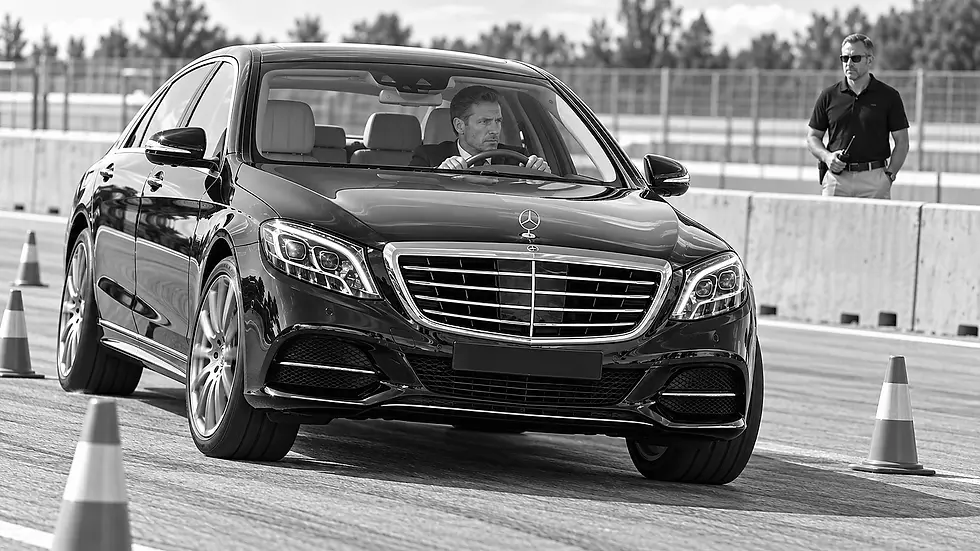
Experience counts as much as certificates. A driver who has worked within protective details understands advance work, vehicle staging and the rhythm of a principal's day.
Licensing requirements vary by country, which is why IPS BODYGUARD only works with licensed local partners in each jurisdiction.
Does a security driver need an armoured vehicle?
No. A security driver does not automatically require an armoured vehicle. The vehicle should match the threat assessment, the route, the client profile and the operational plan. Depending on the circumstances, a suitable solution may be a standard executive vehicle, an unmarked discreet vehicle, a reinforced or armoured vehicle, the principal's own vehicle, or several vehicles within a protective convoy.
For many executives, a discreet vehicle driven by a well prepared professional offers a better balance than an imposing armoured car that draws attention. Vehicle selection should follow a professional risk assessment rather than appearance or prestige.
When to hire a security driver instead of a chauffeur
Situations where a security driver is recommended
A chauffeur is generally appropriate when there is no identified security concern and your priority is high quality transportation, for example corporate meetings, hotel transfers, weddings or VIP hospitality. Is a chauffeur suitable for executive protection? On its own, rarely, because executive protection requires planning and coordination that fall outside a standard chauffeur's remit.
A security driver becomes the better choice when you face a known or elevated threat, a spike in public or media visibility, sensitive business travel, unpredictable schedules, unfamiliar environments, or when an existing close protection operation needs a driver who speaks the same operational language.
The central question is simple. Do you need transportation, or protected mobility?
Is a security driver more expensive than a chauffeur?
Why protected mobility can cost more
Usually, yes, because the service covers more than driving time. Pricing reflects driver qualifications, the security planning included, vehicle type, number of personnel, route complexity, operating hours, risk level, the need for advance work, travel distances and whether several vehicles or a full protection team are involved.
Comparing hourly rates alone is misleading, since a lower priced chauffeur service may not include the protective planning a sensitive assignment requires.
Good to know
A short preliminary risk assessment often clarifies whether a premium chauffeur is enough or whether a security driver is justified, which helps avoid paying for either too little or too much protection.
How to choose a security driver in France
If you are looking for a security driver in France, and particularly a security driver in Paris, look beyond the car and the driving licence. A chauffeur is chosen for driving skill and service. A security driver is chosen for route planning, arrival assessments and the ability to work within a wider protective plan, so ask how each journey will be prepared before it starts.
Local knowledge also matters. Arrivals at Aéroport Paris-Charles de Gaulle, hotel forecourts in central Paris and congested boulevards during major events all require specific route planning and vehicle staging. Before committing to any provider, a few questions help separate genuine protective driving services from upgraded chauffeur offers.
Is the driver primarily a chauffeur, a security professional, or both?
What protective and evasive driving training has been completed, and what close protection experience does the driver have?
Are route planning, alternative routes and arrival point assessments included?
What happens if the itinerary changes at short notice?
Can the driver coordinate with an existing security team, and is a second protection professional recommended?
Who remains responsible for the principal once they leave the vehicle?
How IPS BODYGUARD approaches protected mobility
At IPS BODYGUARD, we design and implement tailored security solutions in which secure transportation is never treated as an isolated service. Every mission starts with a risk assessment and mission planning, then we select suitable security drivers and close protection officers from our network of licensed local partners. The result is one consistent standard of service, whether the movement is a school run on the Côte d'Azur, an executive arrival at a Dubai hotel or a multi city business trip.
This approach is designed for clients who travel across borders and want one accountable point of contact. We set up and manage protective operations in more than 100 countries, aligning travel security, route planning and close protection under a single security programme, so that the quality of protected mobility does not change when the destination does.
Choosing between a security driver and a chauffeur
The security driver vs chauffeur choice is ultimately a question of scope. A chauffeur transports you comfortably and reliably. A security driver combines professional driving with protective planning, threat awareness, emergency capability and integration into a close protection detail. Neither is better in absolute terms, but each answers a different need.
Evaluate training, responsibilities, route planning, coordination and legal compliance rather than the label, and let a professional risk assessment guide the level of service you truly require.

FAQ
Can a security driver use my own vehicle?
Yes, provided the vehicle is suitable for the assessed risk and is properly maintained. The security driver will usually inspect it, check its readiness and integrate its characteristics into the route and emergency planning.
Do security drivers handle private aviation transfers?
They can. Transfers between private terminals, hotels and residences benefit from the same planning logic, with pickup points assessed, timings aligned with the flight schedule and vehicles staged for a smooth departure.
Will a security driver stand out in public or on camera?
A well prepared security driver is chosen and briefed to blend into your environment. Dress code, vehicle choice and behaviour at arrival points are adapted so that protection remains present without being conspicuous.
Can the same security driver accompany me in several countries?
It depends on local licensing and legal requirements. In many cases, the more practical solution is to maintain one consistent standard and one point of contact while suitably qualified local partners deliver the driving in each country.
How far in advance should I book a security driver?
As early as possible, especially during major events or peak seasons, because route reconnaissance and advance work take time. Short notice requests can still be handled, but earlier planning allows a more thorough preparation of routes and arrival points.
Final thoughts on security drivers and chauffeurs
Understanding the difference between a chauffeur and a security driver helps you align ground transport with your actual risk profile. When movement itself carries no particular exposure, a high quality chauffeur service is often enough. When reputation, visibility, destinations or circumstances increase exposure, integrating a trained security driver into a wider protective plan turns each journey into a managed security asset rather than a vulnerability.


Comments