
The Five Roles Inside a Close Protection Detail
Updated: Sep 29
Most people picture close protection as one person walking beside another. In practice, a serious arrangement is a small set of clearly separated roles, and its quality depends on how well those roles are divided rather than on how many people are visible. Understanding who does what tells a client what is actually being paid for, and tells an experienced professional where they fit.
The five roles below exist across the sector, in France and internationally. The titles vary from one country to another, the responsibilities do not.
The team leader
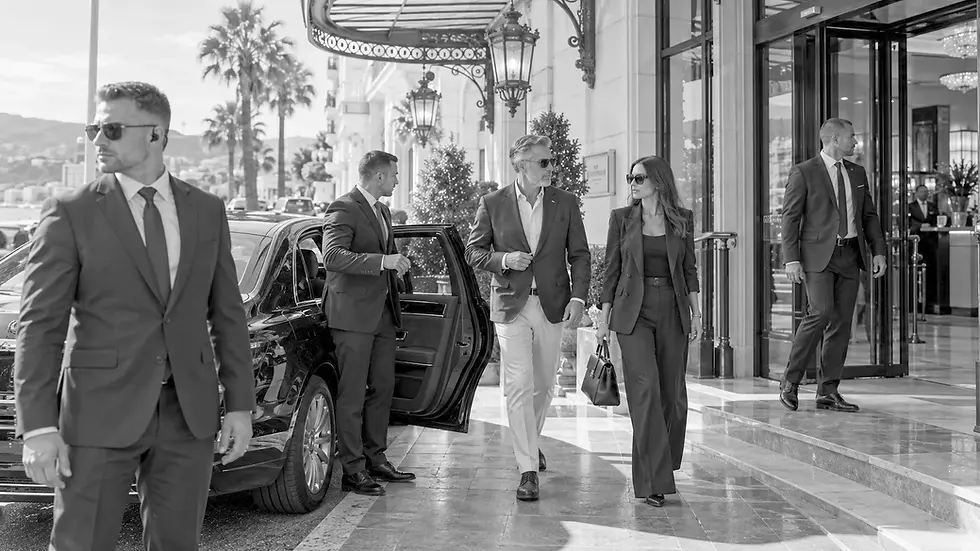
The team leader owns the plan and the decisions. Before the assignment, this is the person who studies the schedule, orders the reconnaissance, decides the size and shape of the arrangement, writes the movement plan and the fallback options, and settles the rules of behaviour for everyone involved. During the assignment, this is the single voice that reallocates people when the schedule changes, which it always does.
The role is more managerial than physical. It calls for planning ability, written clarity, calm under pressure and the authority to say no to a client politely and be understood. It is usually filled by someone who has already spent years in the other four roles.
The close protection officer
This is the role closest to the client, and the most misunderstood. The work is observation, distance management and positioning: reading a room on entry, identifying the exits, watching hands and approaches rather than faces, keeping the right gap in a crowd, and steering the client away from a problem long before it becomes physical. The visible part of the job, the intervention, is the part that should almost never happen.
It also involves a great deal of social discipline. The officer spends whole days inside someone's private life, sees and hears everything, and says nothing. Professionals in this role are expected to be presentable in every setting the client moves through, from a board meeting to a family holiday, and to remain entirely forgettable in all of them.
The security driver
The security driver is the most underrated role in the sector and often the most decisive one. A vehicle is where a protected person is least able to move and most exposed to a planned act, which is why driving is a specialty and not a task handed to whoever holds a licence.
The work includes route study with primary and alternative options, knowledge of traffic restrictions and controlled access in force that week, embarkation and disembarkation discipline at every stop, maintaining space around the vehicle in traffic, and defensive and evasive driving technique. A driver who knows the city, its closures and its hospital locations contributes more to safety than an additional person on foot.

The advance and reconnaissance specialist
This role works ahead of the client, never beside them. It surveys venues, hotels, restaurants, airports and private residences before arrival: entrances and service doors, lift and stairwell layouts, waiting times, parking and drop off points, who controls access and how it is obtained, where a discreet exit exists, where the nearest emergency care is located.
The output is practical: a written brief the rest of the team can act on, and answers to the questions nobody wants to be asking in the moment. On international assignments the role widens to local conditions, customs and equipment rules, the reliability of local services and the real security situation in the specific district being visited rather than in the country as a whole.
The residence and venue specialist
The fifth role is static and continuous. It covers residences, villas, offices, yachts and event venues: access control at the entrance, guest list management, perimeter observation, alarm and camera monitoring, coordination with house staff, and reception of deliveries and visitors. During an event it also covers guest flow and the boundary between public areas and private ones.
The skill set is different from the mobile roles: patience, consistency over long shifts, meticulous logging, and the ability to refuse entry to someone insistent without creating a scene. In residential work, the relationship with household staff often matters more than anything technical.
France and international, the same job under different rules
The five roles are the same everywhere. What changes is the legal frame. In France the profession is regulated and requires a valid professional card, obtained through state approved training, and there are strict rules on what may be worn, carried and done. Abroad, requirements differ widely: some countries require a local licence and permit protection only through locally established companies, others restrict the role to unarmed observation, others again reserve certain functions to public services. This is why an assignment abroad is built on licensed local partners rather than on people flown in.
IPS BODYGUARD designs and coordinates these arrangements. The specialists on an assignment are employed by licensed local partners in the country concerned, and our work is to define the arrangement, select the right profiles for it, brief them against the client's schedule and remain the client's single point of contact throughout.
Joining the network
We are continuously looking for qualified professionals in all five roles, in Europe, the Middle East, Asia and the Americas: team leaders, close protection officers, security drivers, advance specialists and residential or venue specialists, as well as licensed partner companies able to deliver assignments locally.
What matters to us is verifiable experience, the required local credentials, working English, and references we can check. Absolute discretion is a condition of entry, not a quality we list. If you work in one of these roles, or you run a company licensed to provide them locally, you can apply to join the network through our applications page, and we will come back to you after reviewing your file.


Comments