
Protection for a Red Carpet Public Appearance in 2026
Updated: 28 minutes ago
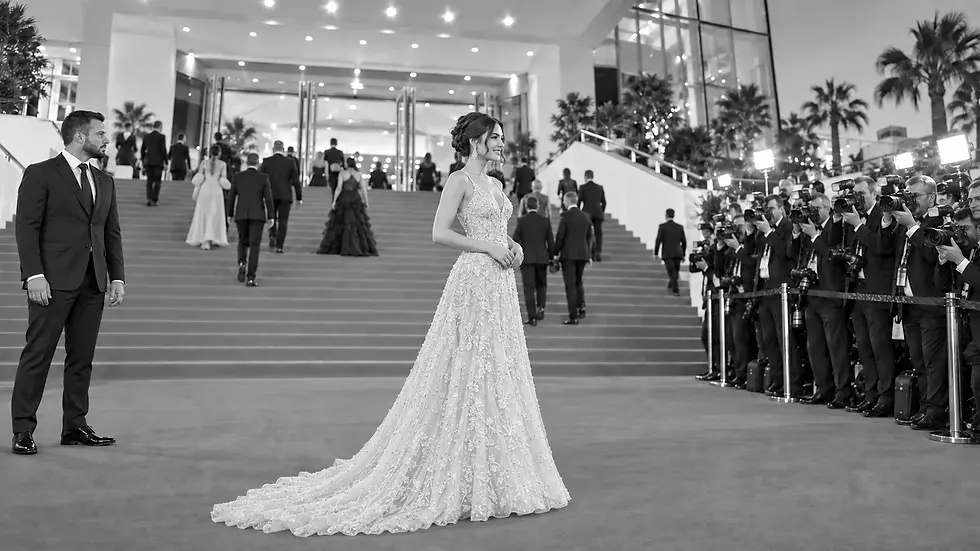
A red carpet looks like a controlled space. In practice, it is one of the most fluid environments a protection team can work in, with photographers, fans, production staff and vehicles converging on a few metres of ground. Protection for a red carpet public appearance is decided long before the car door opens, in threat assessment, site survey, flow mapping and extraction planning.
At IPS BODYGUARD, we design and manage this type of mission in more than 100 countries through a network of licensed local security partners. What follows is the behind the scenes view of how a premiere, an awards ceremony or a brand appearance is actually prepared, from the first briefing to the written after action report.
Protection for a Red Carpet Public Appearance in 2026
Reading time: ~13 min
What Protection for a Red Carpet Public Appearance Actually Includes
Scope of protection around the red carpet
Red carpet security is not a single service. It is a protective envelope that covers the principal, the vehicle arrival point, the carpet itself, the press line, the step and repeat area, the fan barricade, the venue perimeter, backstage corridors, the holding room and the departure route. Each of these zones has a different owner, a different crowd density and a different legal status, which is why a serious plan treats them as separate problems that have to connect seamlessly.
This also answers the question people ask most often, the difference between celebrity close protection and VIP event security. Close protection is centred on the person: an officer moves with the principal, manages proximity, intercepts unwanted contact and controls the pace of movement. Event security is centred on the site, with access control, credentialing, perimeter staffing and crowd management across the whole venue.
At a premiere or an awards ceremony, the two disciplines overlap, and the quality of the operation depends on whether they share one command structure or work in parallel without talking to each other. Our approach to protective operations and event security planning is built on that single chain of command.
Discipline | Focus | Typical activities |
Close protection | The principal | Proximity management, intercepting unwanted contact, controlling pace of movement |
Event security | The site | Access control, credentialing, perimeter staffing, crowd management |
Combined operation | The whole mission | Shared command structure linking the principal's movement to the venue plan |
Threat and Vulnerability Assessment Comes Before Anything Else
Separating threat, vulnerability and risk on the carpet
Every credible plan starts with a documented threat and vulnerability assessment. Three terms are kept separate. A threat is a specific indication of potential harm. A vulnerability is a weakness that could be exploited, such as an unsecured service door or a predictable departure time. Risk is the combination of likelihood and impact. Confusing the three is how teams end up buying manpower instead of buying safety.
For a security planning exercise around a celebrity appearance, the assessment looks at the principal's threat history, any recent approach or correspondence, known fixated individuals, the level of media exposure in the days before the event, the venue profile, the expected attendance, local protest or crime conditions and the online conversation around the appearance.
Behavioral threat assessment matters more than appearance based judgement here, since the warning indicators are usually behavioural: repeated approach attempts, unusual knowledge of the principal's movements, attempts to obtain credentials, escalating language or persistent online threats. Digital threat monitoring supports this work by flagging leaked arrival times, location exposure and coordinated harassment, and it should always be collected lawfully and proportionately rather than treated as a substitute for physical measures through dedicated digital threat monitoring.
Good to know
Schedule leaks are a recurring vulnerability at premieres and awards ceremonies. When the arrival window circulates publicly before the event, crowd density at the barricade and the number of opportunistic approaches both increase, which usually means revisiting the arrival time rather than adding officers.
Advance Work and the Site Survey
Site survey checklist for red carpet security
Advance work is the least visible and most valuable part of red carpet security. An advance agent or security supervisor walks the venue before the principal arrives, ideally during a rehearsal or load in, and again shortly before arrival. Specialist providers commonly describe a final advance sweep between thirty and ninety minutes before the principal arrives, with the exact timing dictated by the venue, the schedule and the threat level.
A practical site survey for a red carpet security checklist usually covers the following points.
Vehicle approach, drop off geometry and the exact door opening position
Primary, alternate and service entrances, and who controls each one
The press line, the interview pen and the step and repeat area, including spacing between the principal and photographers
Fan barricade construction, anchoring, length and the pressure points where a crowd surge is most likely
Backstage corridors, restrooms, elevators, staircases and the designated safe holding area
Emergency exits, responder access routes and the position of medical resources
CCTV coverage, lighting, blind spots and any elevated positions overlooking the carpet
Communications, radio coverage inside the building and the contact list for venue, police and medical liaison
The survey is written down. A plan that lives only in the team leader's head cannot be audited, handed over or defended to a family office or a board, which is exactly what structured documentation and security audits are for.
Crowd Management, Access Control and the Layered Security Model
Crowd management and crowd control are not the same thing. Crowd management is the planning discipline: safe movement, communication, access, circulation and evacuation. Crowd control is the intervention that happens when an immediate safety issue appears, and at a public event the heavier interventions sit with public authorities. Event Safety Alliance guidance treats private security as one component of event safety alongside emergency planning, communications and venue design, not as a replacement for the rest.
The American national standard ANSI ES1.40-2023 organises event security planning around three phases of crowd movement, ingress, circulation and egress. That framing is useful on a carpet because teams instinctively over invest in the arrival moment and under plan the departure. Credentialing is the quiet backbone of the whole system, with verified passes for media, vendors, production staff and guests, and a defined procedure for lost or duplicated credentials.
A layered security model means the principal is never the first line of defence. Perimeter staffing, access control, barriers and controlled lanes, plainclothes surveillance around the fan line, CCTV operators, police liaison and close protection officers each add a layer that can detect, delay, communicate or respond. The purpose of private security at high profile events is to resolve a problem at the outer layer so it never reaches the inner one.
Where the Officers Stand and How Many Are Needed
Officer positioning and protective formations
There is no universal number. A single close protection officer may be appropriate for a low exposure appearance in a controlled venue, while a major premiere with a long carpet, a dense fan line and multiple media positions can require a protection detail plus perimeter and crowd management staff under a security director. The honest answer to how many officers a celebrity public appearance needs is that the figure comes out of the assessment, driven by carpet length, crowd size, number of access points, the principal's exposure and the number of transitions between vehicle, carpet, venue and departure.
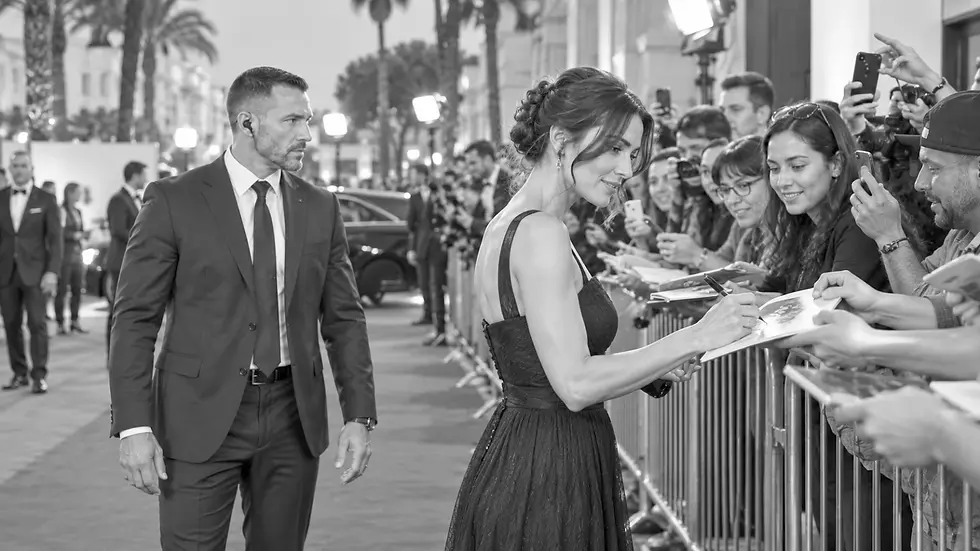
The protective formation adapts as the environment changes. Movement along the carpet is usually open and low profile to preserve the media value of the appearance, tightening at known pressure points such as the barricade curve, the press pen entry and the doorway transition. Officers hold positions that keep an open route around the principal at all times, maintain a line of sight to the fan line and keep a hand free.
Interception procedures are agreed in advance, including who intervenes on a barrier breach, who stays with the principal, and the incident escalation threshold that converts an observation into an action. Interview stops are planned, not improvised, with defined points where the principal pauses and points where movement must remain continuous.
Route Planning, PACE and Emergency Extraction
Route planning for a VIP security plan on a red carpet follows PACE methodology, primary, alternate, contingency and emergency. The primary route is the one everyone sees. The alternate exists because a carpet can be blocked by a crowd surge, a medical incident or a production overrun. The contingency route covers a longer disruption, and the emergency route exists for one purpose, moving the principal out of the environment quickly and into a secure vehicle.
An emergency extraction is rehearsed mentally by every officer before the principal arrives, with a confirmed safe holding area, a vehicle kept in a position that can move without reversing into a crowd, and a driver who stays with the car. Secure transportation is part of the protective plan, not an afterthought, and the link between the carpet and the vehicle is often the most exposed moment of the evening. Departure deserves particular attention because the schedule becomes predictable, attention has dropped, staff are tired and fans drift towards the vehicles.
Important
A route is never secure simply because it is familiar. It has to be reassessed on the day for crowd density, vehicle access, exits, visibility and communications, because a carpet layout can change between rehearsal and showtime.

Working with Organisers, Venues and Police Liaison
Private security does not hold police powers. The United Nations Office of Counter Terrorism recommends joint planning between organisers, police, emergency medical services, health agencies and private security providers for major events, and that principle scales down well to a premiere or a brand appearance. In practice, coordination means an agreed command structure, a shared incident escalation path, documented responsibilities, confirmed emergency access and a named point of contact on each side.
For prestige events in Cannes, Paris or Monaco, this also means respecting the organiser's media objectives. A carpet exists to be photographed. A protection team that blocks every lens or crowds the frame damages the client's purpose as surely as a team that lets a stranger reach the principal. Discretion is an operational requirement, not a style preference.
Qualifications, Documentation and What Drives the Cost
INTERPOL's major event security material states that private security personnel should be individually licensed by the relevant government authority and operate under national certification standards, which is the baseline question to ask any provider. In the United Kingdom, that means an appropriate Security Industry Authority licence for the role. Beyond licensing, a close protection officer working celebrity appearances should bring first aid capability, crowd management awareness, behavioral threat assessment training, radio discipline and genuine experience of media environments. Language skills and local knowledge of venues, traffic restrictions and emergency resources are decisive in an unfamiliar city.
Pricing cannot be quoted as a flat rate, and any provider offering one has not read the venue. The main variables are listed below.
Variable | Why it matters |
Principals and family members present | Each person adds proximity and movement to manage |
Assessed threat level | An active fixated individual case raises staffing and monitoring needs |
Duration and hours on site | Includes advance work time, not just the visible appearance |
Venue complexity | Carpet length and number of access points to cover |
Expected attendance and media volume | Drives fan exposure and crowd management staffing |
Secure transportation | Number of vehicles and driver requirements |
Travel and local legal requirements | Accommodation and host jurisdiction rules |
Scheduling lead time | Last minute bookings compress the advance phase and raise cost |
As a rule, security planning for a celebrity appearance should begin as early as the invitation is confirmed. Four to six weeks gives room for assessment, survey and liaison. For a new client, allow 24 to 72 hours minimum: the assignment starts once the contract is signed and payment is received. The more time we have, the better we can organise and the higher the quality of service.
After the Carpet, the Debrief Nobody Sees
The mission does not end when the vehicle leaves. A professional provider confirms the principal has departed safely, secures the records, runs a team debrief and issues a written after action report covering incidents, near misses, interventions, intelligence gathered and corrective actions. That report feeds directly into the next appearance, because a public figure who attends a film festival in May, a grand prix in spring and an art fair in winter is facing a season, not an event. Updating the threat assessment after each appearance is how a protection programme improves rather than repeating itself.
Planning Your Next Red Carpet Appearance
Good red carpet protection is almost invisible. The principal walks a carpet, gives the interviews, meets the right people and leaves on schedule, and nothing appears to have been managed. Behind that, there is an assessment, a site survey, a credentialing plan, a layered perimeter, a protective formation, a PACE route set and a liaison structure with the venue and the authorities.
At IPS BODYGUARD, we build that structure for premieres, awards ceremonies, festivals and brand appearances, with the same standard applied in Cannes, Paris, Monaco or anywhere else a season takes you, through vetted local partners and one accountable point of contact. If an appearance is already in the diary, the right moment to start is now, and a short conversation is usually enough to define the scope of the assessment.
FAQ
Can a protection detail stay discreet when everything is being filmed?
Yes, and it is a core requirement at media events. Positioning, clothing that matches the guest dress code, limited radio handling in frame and a low profile formation allow officers to work without appearing in every photograph. The brief should state explicitly how visible the client is willing for the team to be.
Is the same level of planning needed for a private premiere or a brand event?
The scale changes, the method does not. A smaller guest list reduces crowd pressure but often increases proximity, since guests expect direct access to the principal. Access control and a clear policy on photographs and introductions matter more than headcount in that setting.
What should a client prepare before a security assessment?
The confirmed schedule, the venue and organiser contacts, the guest or media accreditation model, the travel plan, any previous incident or correspondence of concern and the list of people travelling with the principal. Accurate information shortens the assessment and improves the plan.
Does digital monitoring replace physical protection at a public appearance?
No. Online monitoring identifies leaked schedules, coordinated harassment and escalating language, which helps a team anticipate. It cannot stop an approach at a barricade. The two work together, and digital findings should be validated before they drive an operational decision.
What happens if the threat follows the principal home after the event?
That scenario is handled by extending the plan beyond the venue, with route variation, residential security measures at the villa or apartment, and a review of the digital footprint. An appearance is a visibility spike, and the days following it often deserve as much attention as the night itself.


Comments