
Cannes and Monaco: Security Logistics of the Riviera Season
Updated: Sep 29
Two of the most demanding weeks in the private security calendar fall within fifteen days of each other, on forty kilometres of coastline. The Cannes Film Festival fills a small city with screenings, dinners, receptions and several thousand accredited photographers. The Monaco Grand Prix turns a principality into a closed circuit, with grandstands built over public roads and a harbour packed hull to hull. Many of the people who attend the first also attend the second, with the same aircraft, sometimes the same yacht, and almost always the same expectation: that nothing about their movements becomes visible.
That overlap is what makes the Riviera season a logistics exercise before it is a protection exercise. A plan started in April is already late. By then the suites are gone, the berths are allocated, the accreditation windows have closed, and the drivers who actually know which side of the Croisette will be open on a given evening are committed to someone else.
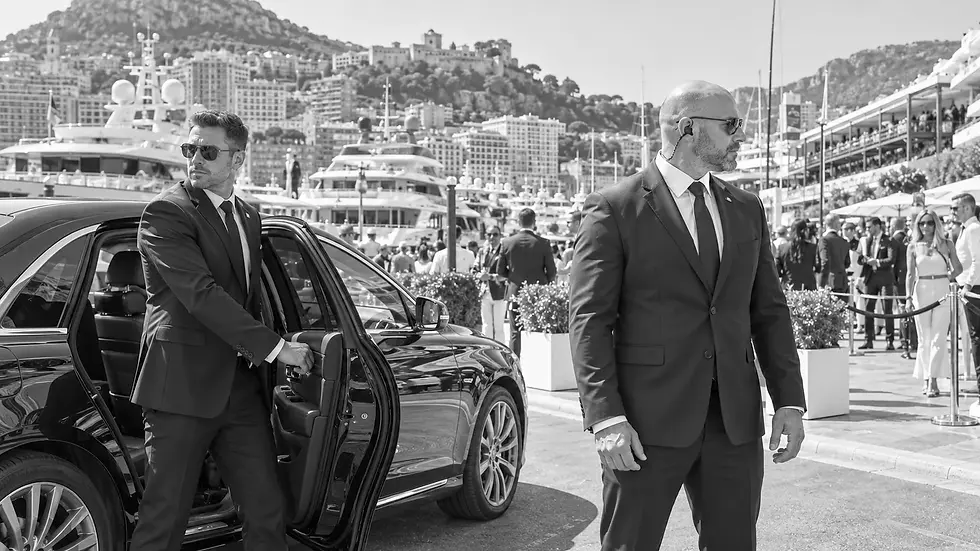
Two events, one clientele, fifteen days apart
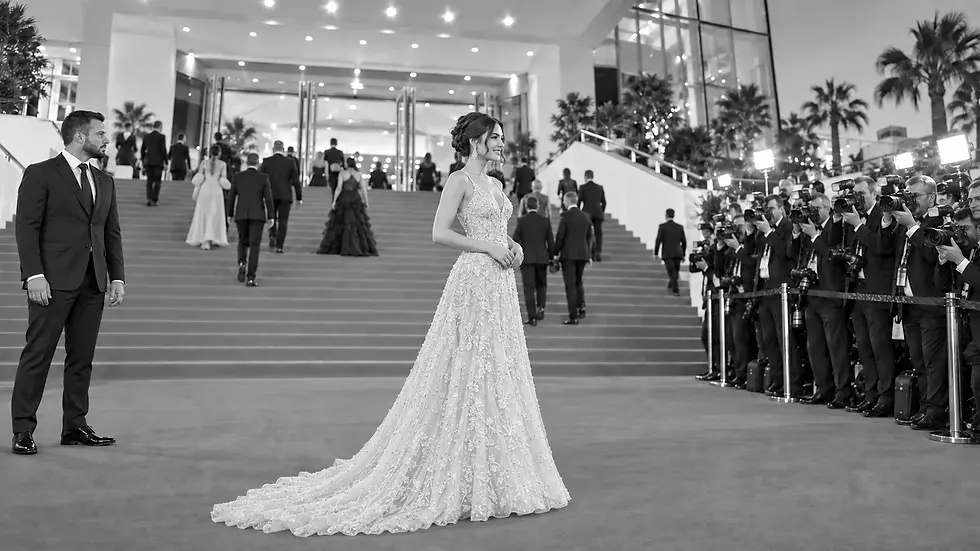
Cannes and Monaco look similar from the outside and behave very differently. Cannes is a pedestrian problem: short distances, saturated pavements, a red carpet that stays for ten days the most photographed point in Europe, and venues whose rear access changes with the screening schedule. Monaco is a vertical problem: a small territory, tunnels and one way systems reorganised for the race, lifts and pedestrian levels that become the fastest way to move, and a harbour that turns into a second city of receptions.
Treating the two weeks as one continuous assignment rather than two separate bookings changes what the client experiences. Aircraft and helicopter slots, vehicles, drivers and venue access are planned together. The same people follow the client through both events, so nothing has to be explained twice, and the preferences learned in Cannes are already known in Monaco.
Saturated cities, filtered access
During both events, you do not simply circulate, you pass filters. Perimeters are set by the local authorities, whole streets are closed to traffic, hotel forecourts are controlled, private venues run their own guest lists, and access to a yacht depends on the marina as much as on the owner. None of this can be improvised at the door. It is obtained in advance, in writing, from the right desk, and checked again the day before, because these arrangements move.
This is also where most of the friction happens. A client stopped fifty metres from an entrance, in front of the cameras, with no alternative route prepared, has already lost the evening. The work consists of knowing where the filters are, holding what is needed to pass them, and having a second way in for every arrival that matters.
Accreditations, berths and rooms are decided in winter
The useful part of the season takes place months before it. Accommodation and berthing are secured early. Accreditation and venue access requests are filed as soon as the organisers open them. Vehicles are reserved with their driver attached, not as an anonymous fleet. Reconnaissance is done on the ground rather than on a map, because the only way to know the service entrance of a beach venue, or the real walking time between two points during festival week, is to have walked it.
By the time the client arrives, every routine question already has an answer: where the car waits, which door is used, who is expecting the client at that door, how long the transfer takes at nine in the evening rather than at noon, and what happens if the road is closed.

Transport is the real constraint
On the Riviera in May, movement is the service. Distances are short and journey times unpredictable. Helicopter transfers between Nice, Cannes and Monaco save an hour and create constraints of their own, since landing slots and ground pickups have to match. On the ground you need vehicles suited to the setting, drivers who know the restrictions in force that particular week, and timings built on the event programme rather than on traffic averages.
The test of a good arrangement is simple: the client arrives at the expected time, at the right entrance, without waiting anywhere longer than necessary.
Discretion is what the client is really buying
Across these two weeks, protection is as much a question of visibility as of safety. The client is photographed, filmed, followed and approached, and a heavy escort becomes a story in itself. What works is a presence calibrated to the setting: close and silent on a carpet or in a crowded reception, wider and less visible in a private villa or on a quay, entirely invisible during the private parts of the programme.
IPS BODYGUARD designs and coordinates these arrangements. Assignments are delivered by licensed local partners present on the Riviera all year round, so knowledge of access, driving and venues stays local while the planning and the single point of contact stay with us.
Lead times and first contact
Lead times depend on the location, the risk level and the scope of the advance work. For a new client, allow 24 to 72 hours as a minimum: the mission starts once the contract is signed and payment has been received. The more time we have, the better we can organise it and the better the service. Existing clients can, depending on the situation, be deployed faster. For the season itself, that is the wrong horizon. Cannes and Monaco are prepared in winter, and a request arriving in the final weeks is limited to whatever access and capacity is still available.
If you plan to attend one of these events, or both, send us the dates, the venues you expect to use and how you intend to travel between them. We will come back with a written proposal covering accreditations, transport and the protection arrangement, and we will tell you plainly what can still be obtained and what cannot. Request a quote to open the file.


Comments